
|
17 July 2026 Europe's Daily Beauty Routine Is Becoming a Health Routine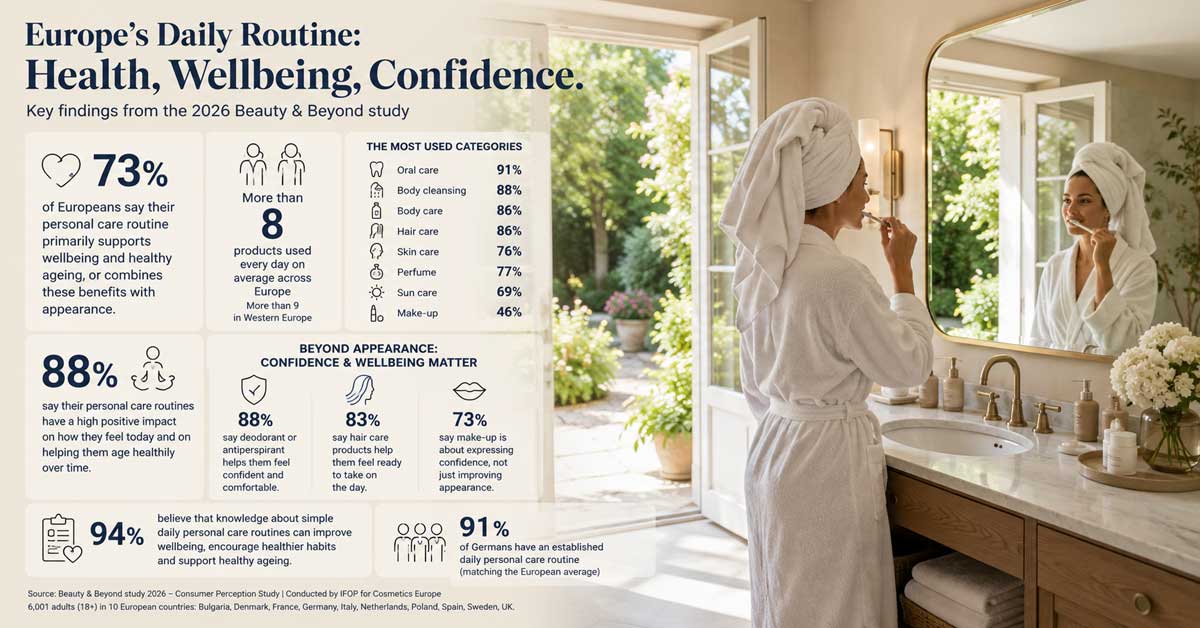
Quick Read
For decades, cosmetics were largely associated with beauty and appearance. A new European consumer study now paints a more nuanced picture. Across Europe, daily routines such as brushing teeth, washing hair, applying sunscreen or using moisturiser are increasingly seen as practical investments in health, wellbeing and confidence. Looking good remains important—but for most Europeans it is no longer the primary reason for reaching for personal care products.
• A new pan-European study shows that health and wellbeing now rank ahead of appearance as the main reason Europeans use cosmetics and personal care products. Health becomes the main motivationThe strongest finding of the 2026 Beauty & Beyond study is the shift in motivation. According to the research, 73% of Europeans say their daily personal care routine primarily supports their wellbeing and healthy ageing, or combines these benefits with appearance. Only 27% describe appearance as the main purpose.The survey was commissioned by Cosmetics Europe, the European trade association representing the cosmetics and personal care industry, and carried out by the market research institute IFOP. Between late 2025 and early 2026, 6,001 adults aged 18 and over were interviewed in ten European countries: Bulgaria, Denmark, France, Germany, Italy, the Netherlands, Poland, Spain, Sweden and the United Kingdom. Austria was not included. Instead, the published results compare four broader European regions—Nordics, Western Europe, Central and Eastern Europe, and Southern Europe. Germany, Austria's neighbouring country, reports that 91% of respondents have an established daily personal care routine, matching the overall European average. The figures underline how widespread these routines have become. Europeans use more than eight cosmetic and personal care products every day on average, while Western Europeans use more than nine. Product categories such as oral care (91%), body cleansing (88%), body care (86%), hair care (86%), skincare (76%), fragrance (77%), sun protection (69%) and make-up (46%) are firmly embedded in everyday life rather than occasional luxuries. Everyday habits with long-term goalsThe study suggests that Europeans increasingly see these routines as preventive rather than purely cosmetic. Brushing teeth is widely understood as protecting oral health and preventing tooth decay. Skincare is associated with maintaining the skin's protective barrier over time, while sunscreen is valued not only for avoiding sunburn but also for reducing long-term skin damage caused by ultraviolet radiation.This preventive mindset extends beyond physical health. Overall, 88% of respondents say their daily personal care routine has a positive impact both on how they feel today and on helping them age healthily over time. Rather than treating personal care as vanity, many consumers appear to regard it as one element of a broader lifestyle aimed at maintaining health, independence and quality of life as they grow older. Confidence matters more than appearanceThe survey also highlights the psychological role of personal care. Looking presentable remains part of the equation, but respondents increasingly describe cosmetics as tools for feeling comfortable and confident rather than simply attractive. Around 79% say make-up is not only about improving appearance but also about expressing confidence, while 75% associate fragrance with feeling better and expressing their personality. Similarly, 88% say deodorants and antiperspirants contribute to confidence and comfort in everyday situations, and 83% believe hair care helps them feel ready to face the day.This broader understanding helps explain why personal care routines are closely linked to participation in daily life. Across Europe, 71% say these routines help them feel focused, prepared and able to perform everyday tasks, while 73% believe they support confident participation at work, in education and in social life. Four out of five respondents also agree that feeling comfortable and confident makes them more productive. A European culture of preventive self-careThe findings point to a wider cultural shift. Cosmetics and personal care products are increasingly viewed as supporting preventive health rather than simply enhancing appearance. Consumers associate oral care with protecting teeth and gums, skincare with preserving the skin's natural barrier, and sunscreen with reducing the long-term effects of ultraviolet exposure. Daily washing and body cleansing are likewise understood as essential hygiene practices that help prevent irritation, infection and discomfort, while contributing to overall wellbeing.Perhaps the most striking result is that 94% of respondents believe that knowledge about simple daily personal care routines can improve wellbeing, encourage healthier habits and support healthy ageing. Rather than treating cosmetics as occasional beauty products, Europeans appear to integrate them into a broader lifestyle centred on prevention, self-care and quality of life. The study was commissioned by Cosmetics Europe, whose members include manufacturers and national industry associations from across Europe. As an industry-funded survey, the findings naturally reflect consumers' perceptions rather than clinical evidence about health outcomes. Nevertheless, the results offer an interesting snapshot of changing attitudes: for many Europeans, the bathroom routine has evolved from a beauty ritual into a daily investment in physical health, emotional wellbeing and self-confidence. Image: Editorial graphic illustrating key findings from the 2026 European Consumer Perception Study. A woman brushes her teeth in a bright bathroom overlooking a garden, alongside an infographic showing how personal care is increasingly linked to health, wellbeing and confidence. © Fashion.at / AI-generated with ChatGPT. |