
|
17 August 2026 Aesthetic Surgery Gets Younger — and Young Patients Want AI Images Labelled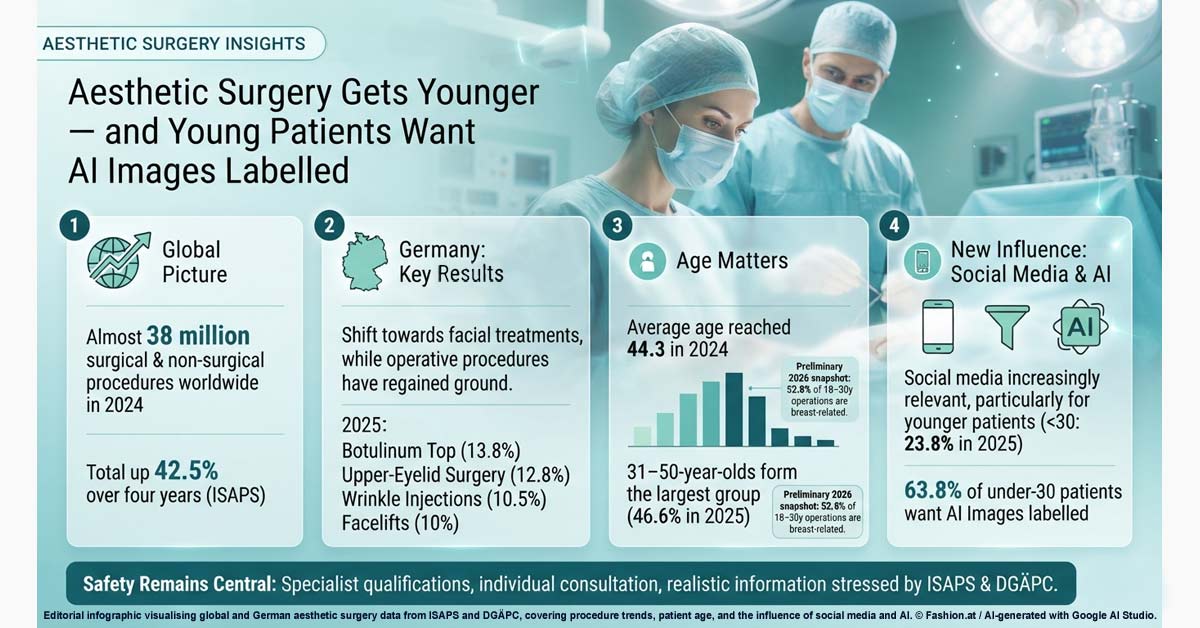
Quick Read
• Global picture: ISAPS reports almost 38 million surgical and non-surgical aesthetic procedures worldwide in 2024, with the total up 42.5% over four years. Two perspectives on a changing fieldStatistics on aesthetic plastic surgery are useful precisely because they put social-media impressions into perspective. Globally, the International Society of Aesthetic Plastic Surgery (ISAPS) provides one of the most extensive international datasets. ISAPS describes itself as the international professional body for board-certified aesthetic plastic surgeons. Founded in 1970, it has members in more than 117 countries and conducts the global survey annually. The latest available global survey covers procedures performed in 2024. It recorded more than 17.4 million surgical and 20.5 million non-surgical procedures performed by plastic surgeons worldwide. Compared with 2020, the combined total had increased by 42.5%.Face, eyelids and a return of surgeryOne striking international change is the growing importance of the face. In 2024, eyelid surgery became the world's most common surgical aesthetic procedure, overtaking liposuction. ISAPS recorded more than 2.1 million eyelid operations, an increase of 13.4% compared with the previous year. Facial fat grafting also increased, while rhinoplasty declined by 10%.The German DGÄPC statistics provide a more detailed patient perspective. Its 2025 survey puts botulinum treatments at the top with 13.8%, followed by upper-eyelid surgery at 12.8% and wrinkle injections at 10.5%. Facelifts accounted for 10% when the lifting procedures are combined, followed by liposuction at 8.7%. The society describes this as a renewed interest in surgery alongside continued demand for minimally invasive treatments. The direction is not simply "more Botox". The figures suggest a more differentiated pattern: minimally invasive treatments remain important, while longer-lasting surgical procedures, particularly in the face and neck, have regained attention. Age tells a different story than social mediaThe German statistics also challenge the impression that aesthetic medicine is steadily becoming a young person's field. According to DGÄPC, the average patient age has risen continuously over the past decade and reached 44.3 years in 2024 (44.5 in 2025). The largest group was aged 31–50, representing 46.5% of patients.The DGÄPC's 2026 summer update, published while the survey is still running, adds another detail: among women aged 18–30, 52.8% of the operations recorded so far concern the breast. Implant augmentation accounts for 14.9%, reduction for 14.4% and lifting for 12.6%. At the same time, botulinum treatment and wrinkle injections each account for only 5% of treatments in this age group. The 2026 survey continues until early October, so these figures are explicitly a preliminary mid-year snapshot, not the final annual result. Relationship status and the digital mirrorThe DGÄPC statistics even distinguish between patients who are single and those who are married or in a relationship. In the 2024 survey, 39.1% identified as single, while 59.6% were married or in a relationship. The treatment preferences differed: among single patients, implant breast augmentation ranked first at 11.5%, whereas among partnered or married patients, upper-eyelid surgery (15.3%), botulinum treatment (14.8%) and wrinkle injections (13.6%) were the leading choices.Perhaps the most contemporary trend concerns the relationship between aesthetic expectations and digital images. DGÄPC reports that social-media influence among patients under 30 reached 23.8% in 2025, its highest value in the five-year comparison. At the same time, 63.8% of under-30 patients said digitally altered images should be subject to mandatory labelling; across the overall target group, the figure was 55.3%. This makes patient education more than a side issue. In its 2025 report, the DGÄPC calls for clearer rules regarding digitally altered and AI-generated images, as well as stronger media literacy. For patients, however, the central conclusion is less about following or resisting a particular trend. Aesthetic procedures are medical interventions. ISAPS explicitly stresses that cosmetic surgery is still surgery, with risks and possible side effects, and recommends choosing a board-certified specialist trained and experienced in the procedure. The consultation with the treating specialist is therefore part of the treatment itself: it should clarify expectations, alternatives, limitations and risks before a decision is made. Image: Editorial infographic visualising global and German aesthetic surgery data from ISAPS and DGÄPC, covering procedure trends, patient age, and the influence of social media and AI. © Fashion.at / AI-generated with Google AI Studio. |